
So shall they fear the name of the Lord from the west, and his glory from the rising of the sun. When the enemy shall come in like a flood, the Spirit of the Lord shall lift up a standard against him. (Isaiah 59:19)
I finished going through Lisa Bevere’s devotional, “Strong” recently. (I highly recommend it.) In it she talks about prayer and one of the things she says is, “If you’re filling up all your prayer time talking, you’re doing it wrong.” Prayer should be a dialogue. So, yes, we ought to talk but a good portion ought to be listening. You’ve heard it said, God gave us one mouth and two ears for a reason, so that we listen twice as much as we talk. When given a chance, He will speak. I’ve heard people say that they just can’t hear God. To them I say. Have you allowed God to get a word in edge-wise? Has God quit speaking or have we quit listening?
Samuel had to learn the voice of his God and didn’t know it initially but we are his sheep and we know his voice — the voice of a stranger we will not follow. It was during one of those moments recently, where my mouth was shut and my ears were open, that God spoke. (Imagine that?) He reminded me of a British tradition and then asked me a question which we will get to later.
Turn your attention to these next few verses:
-
Leviticus 26:11-12 “And I will set my tabernacle among you: and my soul shall not abhor you. (12) And I will walk among you, and will be your God, and ye shall be my people.”
-
Ezekiel 37:27 “My tabernacle shall also be with them: yea, I will be their God, and they shall be my people.”
-
2 Corinthians 6:16 “For ye are the temple of the living God; as God hath said, I will dwell in them, and walk in them; and I will be their God, and they shall be my people.”
What an awesome and humbling privilege to be called the people of God! These verses may look exactly the same but, if you read carefully, there is a slight difference between the first two verses and the third. Do you see it? In the two Old Testament verses, God says that He will set His tabernacle among and with them. In the New Testament the wording changes. Instead of placing His tabernacle among the us, we become the tabernacle and He dwells IN us and walks IN us! Now if that doesn’t set your toe to tapping and your pulse to racing, well, I just don’t know what to say.
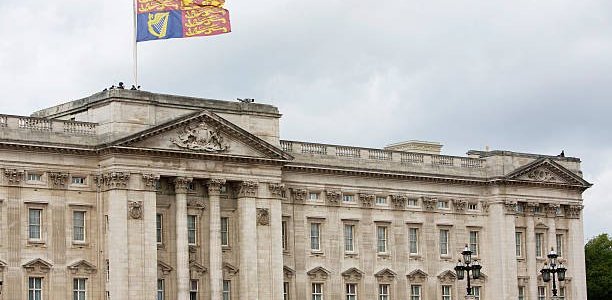
In Great Britain, there is a tradition. This tradition involves a flag, a Sovereign, and a palace. The palace is the dwelling place of the Sovereign, and the flag, is very fittingly called the Royal Standard. When the Sovereign is in residence at Buckingham Palace, the standard is raised to indicate as such. When they leave, the flag is lowered. When they go to Balmoral, the flag is raised there. Windsor Castle, same. Car? Two little flags flutter on either side of the hood. Airplane? Yup, there too. (Maybe not fluttering but affixed in a very secure and safe manner.)
You get the idea. Wherever the sovereign is, the standard is raised. Anybody walking by, from lord to chimney sweep only has to do one thing to know whether or not the Sovereign is in residence. Look up. Now this is where God asked his question. “You are meant to be my dwelling place. Can anyone walking by you tell that I am in residence by the standard that you have raised?” Whew. Can I just tell you that when God asks a question like that, He already knows the answer. Like the woman at the well, who had the choice to gloss over some of her less savory moments in her past chose transparency and truthfulness, He wants to see if you’ll answer honestly. So I ask you the same question. Can anyone walking by you tell that God is in residence by the standard that you have raised? Our lives ought to shout His presence. A godly clamor. A holy roar amidst the chaos of this world. There ought to be no doubt Whose we are. Raise the Standard and let Him shine!

 Things Pondered